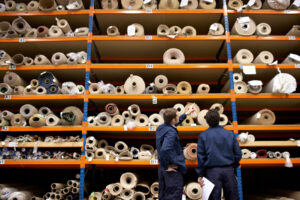
Walk into a warehouse that is running out of space and ask what the solution is.
Very often, the answer comes quickly:
“We need heavier racks.”
Maybe. But maybe not.
I’ve seen businesses assume that if their warehouse is becoming crowded, they should simply move from medium-duty shelving to heavy-duty pallet racking. It sounds logical. Bigger racks. More capacity. Problem solved.
Except warehouses rarely work that neatly.
The real question isn’t “Which rack is stronger?”
It’s “What are you actually storing, how are you handling it, and how often do you need to access it?”
That small difference can save a business from spending money on a system it doesn’t really need.
Medium Duty vs Heavy Duty: The Difference Isn’t Just Weight
At first glance, the distinction seems straightforward.
Medium-duty racking is generally suited to products that can be stored manually or with relatively light handling equipment. Heavy-duty racking is designed for substantially heavier loads, commonly involving pallets, forklifts, and higher storage loads.
But capacity is only part of the story.
Think about a spare-parts warehouse.
You might have cartons of bearings, electrical components, tools, packaging materials and replacement parts. Some boxes may be fairly heavy, but they aren’t necessarily stored on pallets or moved around with a forklift.
In that situation, a properly designed medium-duty storage system can make much more sense.
Now imagine a distribution warehouse receiving pallets of packaged goods every day.
Those pallets may weigh hundreds of kilograms, and forklifts need to place them several metres above the floor.
That’s a completely different storage problem.
And that’s where heavy-duty pallet racking starts to make sense.
So what does that actually mean?
The right choice depends on the operation—not simply the weight printed on one carton.
You Might Think Heavy Duty Is Always Better
This is one of the most common assumptions.
If heavy-duty racks can carry more, why not install them everywhere?
Because you’re not buying maximum capacity for the sake of maximum capacity.
You’re buying a storage system that needs to fit your products, building, handling equipment, workflow and budget.
Imagine a small warehouse storing 30–40 kg cartons that workers pick by hand.
Installing a large pallet racking system designed around forklift access may create unnecessary aisle requirements and make everyday picking less convenient.
The rack might be stronger.
But the warehouse could actually become less practical.
Here’s the thing: more capacity doesn’t automatically mean better storage.
The system has to match the way your warehouse operates.
Where Medium Duty Racking Starts Making Sense
Medium-duty systems are often useful in warehouses where products are handled manually and don’t require pallet-level forklift storage.
Consider an e-commerce operation.
A worker receives cartons, places them onto shelves, walks through the aisle, picks individual products and prepares orders for dispatch.
The warehouse doesn’t necessarily need every product sitting on a pallet.
It needs accessible storage.
That’s an important distinction.
Medium-duty racking can be useful for spare parts, packaged goods, tools, components, documents, small equipment and other products where workers need regular access to individual items.
It can also make sense for businesses that are growing but aren’t yet operating a full pallet-based warehouse.
That is where Medium Duty Racking Services in UAE can become relevant—not because medium-duty automatically means “small,” but because the system can be designed around a different type of workflow.
When Heavy Duty Racking Becomes the Practical Choice
Now change the scenario.
Your warehouse receives palletised goods.
A forklift unloads the truck.
The pallets need to be stored vertically to make better use of the available height.
Orders are picked by pallet, or pallets are moved frequently between receiving, storage and dispatch.
That’s no longer a simple shelving problem.
It’s a pallet-racking problem.
Heavy-duty systems are commonly used for these environments because the rack structure, beams, frames and configuration can be designed around substantial pallet loads and mechanical handling.
But there’s another important point.
The rack capacity isn’t something you should guess.
It depends on the actual configuration.
Beam length, upright dimensions, number of storage levels, pallet dimensions, load distribution and other design factors all matter.
A rack that looks identical from the outside can have a very different safe working capacity depending on how it is configured.
Don’t Choose a Rack Before You Know Your Load
This is where I would slow the conversation down.
Before asking a supplier, “How much does heavy-duty racking cost?”, first ask yourself:
What exactly am I putting on it?
Not approximately.
Actually measure it.
What is the pallet size?
What does a loaded pallet weigh?
Are the loads evenly distributed?
Will the weight change during the year?
How many pallets need to be stored?
How many levels do you want?
What equipment will place and remove those loads?
These questions sound basic, but they determine the design.
And if you’re comparing Medium Duty Racking Services in UAE, these details are just as important. A supplier should be interested in your application rather than simply trying to put a standard rack into an empty warehouse drawing.
The Forklift Question Changes Everything
Here’s something businesses sometimes overlook.
The rack doesn’t operate by itself.
If you’re installing heavy-duty pallet racking, you also have to think about the equipment moving the pallets.
What type of forklift are you using?
How high can it safely reach?
How much aisle width does it need?
Can it manoeuvre comfortably between the rack rows?
What happens at the end of each aisle?
A rack layout that looks efficient on paper can become frustrating when the forklift operator has to make awkward movements every few minutes.
That’s why warehouse design is really a combination of storage + handling + movement.
The rack is only one part of the system.
And Then There Are Accessories
Heavy-duty storage isn’t just about frames and beams.
Depending on the application, a warehouse may need accessories such as pallet supports, row spacers, upright protectors, safety components or other rack-related equipment.
This is where searches for Heavy Duty Racks Accessories in Dubai often come from.
A business may already have pallet racks but discover that the supporting components don’t match a new storage requirement.
Or perhaps the warehouse is being rearranged and additional protection is needed around rack uprights and forklift traffic areas.
The lesson is simple:
Don’t price the rack as an isolated product.
Look at the complete storage arrangement.
A cheaper rack can become expensive if the supporting components, installation requirements or modifications are ignored at the beginning.
What About a Warehouse That Is Somewhere in Between?
This is probably the most interesting situation.
Suppose you’re running a growing business.
Today, most products are cartons handled manually.
But you’re starting to receive more palletised inventory.
You expect volumes to increase over the next two or three years.
Do you buy medium-duty shelving now and replace it later?
Or do you install heavy-duty pallet racking immediately?
There isn’t one universal answer.
This is where planning matters more than simply comparing two product categories.
If growth is predictable, designing the warehouse around future requirements may avoid unnecessary replacement work.
But if the future operation is uncertain, oversizing everything today can tie up capital and warehouse space that could be used elsewhere.
The problem is that nobody can design a sensible system from the phrase “we’re growing.”
You need numbers.
Current stock.
Expected stock.
Pallet count.
SKU count.
Movement frequency.
Available floor area.
Ceiling height.
Handling equipment.
Those details turn a vague expansion plan into an actual storage requirement.
Medium Duty Racking Services in UAE: What Should You Ask?
If you’re considering medium-duty storage, don’t begin with the catalogue.
Begin with the warehouse.
A useful supplier discussion should cover the dimensions of the available area, product weights, shelf levels, access requirements and the way workers will actually use the system.
Ask how the proposed load capacity was determined.
Ask whether the shelves are adjustable.
Ask about installation.
Ask what happens if your storage requirements change.
And importantly, ask whether the proposed configuration is suitable for your actual products.
A rack isn’t useful simply because it fits inside the building.
It has to work inside the operation.
A Quick Real-World Comparison
Let’s say you operate two warehouses.
Warehouse A: Spare Parts
You store thousands of small and medium-sized components.
Workers pick individual boxes throughout the day.
Most items are below pallet weight, and forklift access isn’t central to the workflow.
A well-planned medium-duty shelving or racking arrangement may be appropriate.
Warehouse B: FMCG Distribution
You receive goods on pallets.
Forklifts move pallets from receiving to storage and then to dispatch.
Products are stacked vertically, and pallet turnover is high.
Here, heavy-duty pallet racking is much more aligned with the operation.
Notice something?
The decision wasn’t made simply by asking which rack is stronger.
It was made by looking at how the warehouse works.
Don’t Forget the Building
There is another mistake worth mentioning.
People sometimes focus so heavily on the rack that they forget the building underneath it.
Before installing a significant storage system, the warehouse floor, available height, access routes, columns, doors, lighting, sprinklers and other site conditions may need to be considered.
For taller or heavier installations, the structural and safety requirements deserve particular attention.
And if forklifts are involved, traffic movement becomes part of the design conversation too.
This is why a warehouse survey can be more valuable than a quick price quote.
So, Medium Duty or Heavy Duty?
If your products are generally handled manually and your storage requirement revolves around cartons, components, boxes or individual items, medium-duty racking may be the more logical direction.
If you’re storing substantial palletised loads and relying on forklifts or other mechanical handling equipment, heavy-duty pallet racking is more likely to fit the operation.
But don’t treat those as rigid rules.
A warehouse can have both.
In fact, a mixed system can sometimes make more operational sense.
Fast-moving palletised stock may sit in heavy-duty pallet racking, while smaller components and order-picking inventory are stored separately on medium-duty shelving.
Why force the entire warehouse into one storage format?
The Questions I Would Ask Before Buying
Before requesting quotations, write down these numbers:
- Maximum weight of the typical storage unit
- Maximum weight of the heaviest load
- Pallet dimensions, if pallets are involved
- Number of pallets or cartons required
- Number of SKUs
- Required storage levels
- Available floor area
- Clear warehouse height
- Forklift or handling equipment being used
- Expected stock growth
- How frequently products are accessed
That information gives a racking supplier something useful to work with.
Without it, you’re mostly comparing prices for products that may not even be equivalent.
The Real Cost of Choosing the Wrong System
Here’s the part that doesn’t always appear on a quotation.
If you choose a system that doesn’t suit your workflow, you may eventually pay for changes, relocation, additional accessories, inefficient aisle space or replacement equipment.
And warehouse space is expensive.
Even when you’re not paying more rent, wasted cubic space has a cost.
That’s why I wouldn’t make the decision based on “medium duty is cheaper” or “heavy duty is stronger.”
Both statements can be true and still lead you toward the wrong solution.
The better question is:
What storage problem are we actually trying to solve?
Final Thought: Start With the Warehouse, Not the Rack
There is a temptation to choose racking the same way we choose ordinary products.
Compare specifications.
Compare prices.
Pick one.
Warehousing isn’t quite that simple.
The right system depends on the products, loads, people, equipment, available space and future plans working together.
So if you’re researching Medium Duty Racking Services in UAE, don’t just ask how much the rack costs.
Ask what the rack needs to do.
And if your operation genuinely requires pallet storage, forklift handling and higher load capacities, then explore heavy-duty racking as a complete system—including the appropriate Heavy Duty Racks Accessories in Dubai where required.
Because the strongest rack isn’t necessarily the right rack.
The right rack is the one that makes your warehouse work better without solving a problem you never actually had.